Wholesale Open Access
We make shared fiber work!

Open Access. Wholesale. Neutral Host. Different labels, same powerful foundation: shared infrastructure. One high-quality fiber network that many providers use to compete, innovate, and give customers more choice.

Why Open Access

Three advantages you can’t ignore

Higher take-rates

than if you market a single service network. In fact, take rates are often up to three times as high – as consumers tend to spend more when given ample choices.

A more profitable

business model because it gives you access to the wholesale revenue streams – it allows you to become a specialist in your field.

Improved  public and private partnerships

as communities can invest in infrastructure and provide their citizens with digital possibilities; without having to compete with commercial consumer services.

What is Wholesale Open Access?

Everybody has a stake to claim in an open market

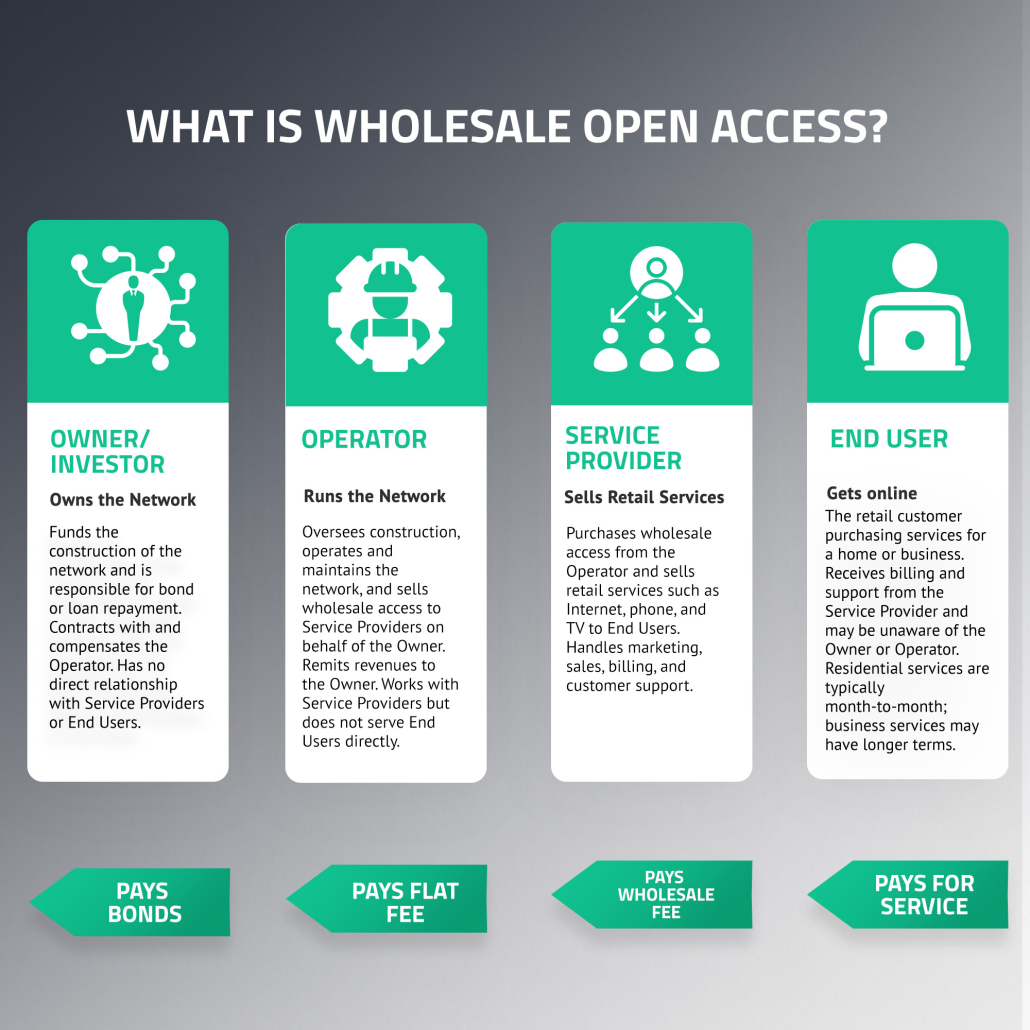
An Open Access ecosystem consists of several distinct roles:

  • A Network Owner, such as a town or municipality, that owns the physical infrastructure and acts as the investor.

  • A Network Operator that manages and maintains the network and oversees daily operations.

  • Multiple Service Providers that market and sell services such as Internet and VoIP to consumers and businesses in a competitive, open marketplace.

In some cases, the Network Owner and Network Operator are the same entity and may also choose to offer retail services directly to the public, while still allowing other providers to compete on the network.

How does it work?

There are layers to this cake

There are three logical layers in an Open Access net:

  1. The infrastructure layer is the physical fiber network. 
  2. The access layer, the electronics and different systems surrounding the infrastructure that is managed by the network operator
  3. The service layer, broadband services, VOIP-services, and so on – sold by service providers to the end customers.

Service providers can market themselves to customers throuh a digital marketplace supplied by the network operator. End customers can sign up for services via the marketplace (if the operator chooses to provide one) or the service provider’s own sales channel.

Service providers charge their end  customer for their services while the network owner and operator charge the service provider a wholesale fee for the used network capacity. COS Wholesale Engine is the wholesale broadband software that automates this model: per-ISP invoicing generated from live activations.

Whitepaper

Want to know more about Open Access?

Download our whitepapers on the subject and get up to speed. You are only a couple of pages away from figuring out your new business model. Click here.

What does it take?

It takes a system to solve the complexities

COS Systems offers two purpose-built solutions for Open Access networks, each addressing different operator needs.

COS Business Engine is a comprehensive BSS/OSS platform that automates complex, multi-provider ecosystems — enabling zero-touch provisioning, automated billing, and a self-service marketplace. Multiple service providers can compete directly on the network, maximizing utilization and take rates while helping municipalities retain control over their infrastructure investments.

COS Wholesale Engine is an API-first Network Orchestrator for operators managing multiple ISPs on shared infrastructure. Its REST API integration layer lets providers plug in their own BSS/OSS systems, while automating provisioning, cross-organization ticketing, and wholesale billing. It also serves as a normalization layer for mergers and acquisitions, making it easier to integrate acquired networks without forcing tech stack migrations.

Together, they cover the full spectrum of open access models — with the automation and scalability to grow.

One Platform –

Every Open-Access Model

COS Systems supports the full spectrum of open-access models—from Tier-1 wholesale FTTH with a single ISP and API-driven ops, through anchor-ISP wholesale, to traditional open access with a marketplace where multiple ISPs sell side-by-side. With COS Business Engine, the network owner/operator retains control of OLTS/ONTs and Layer-2 provisioning while services are zero-touch and wholesale settlements are generated automatically; ISPs manage their own catalogs and support, and subscribers self-serve in the customer portal. This layered approach (infrastructure, operations, services) lets each party specialize, boosting take-rates with more choice while scaling operations through orchestration and integrations.

Do we have to go all-in?

There are four approaches to Open Access:

In this approach, all  the different “logical layers” are separated. The network owner is one entity (usually a community), the network operator another and the service providers are separate from them.

This is often the case in larger community networks where it also makes sense to build up operational capacity. There are also examples of private businesses that realize the potential of selling capacity wholesale instead of services.

This is where a network owner/operator also markets a digital service to the public to supplement the wholesale revenue stream.

The traditional telco or ISP business model, but supported by a BSS/OSS-system that is built for Open Access. This makes it possible to open up the infrastructure for multiple service providers at any time.